Showing posts with label Hall of Fame. Show all posts

Sunday, 5 May 2024

1972 Hall of Fame Class


Member #36: LB Rusty McVee - Brampton, ON - 1st Ballot - Creator: Scratch
Rusty broke into the league as a rookie in 1953 after being drafted 4th overall by the Montreal Rouge. His first year would be a great one as he made an immediate impact. He would help Montreal to their 2nd McCallister Cup in 3 years and take home Rookie of the Year. He would earn his first All-Star the next year in 1954, but the team fell short of a repeat. While McVee was just getting into his prime, the Rouge would slip into a deep rebuild, going 2-8 in back-to-back seasons. The poor form would lead to McVee desiring a trade. His request would be granted and Montreal would trade McVee to Long Island. His first year on Long Island would be a little rocky with McVee struggling to fit into the new team, but by his second season, they would figure it out. The Raiders’ defence would become one of the best defences in the league’s short history en route to a McCallister Cup win in 1958. McVee would win the McCallister Cup and Playoff MVP during the run as well. The next two seasons would both still be good with the Raiders finishing atop the West Division in both years, however, fell short of a championship. In 1960, the Raiders would face a cap crunch with the salary cap being introduced so the Raiders would have to let go of McVee. McVee would sign with the Providence Gold Stars and would then take them to a competitive spot, including a McCallister Cup appearance in 1963, marking the 3rd team he has gone to the big game with, however he fell short of a 3rd ring. After the cup run, McVee would leave the Gold Stars and head home to join the Toronto Steelheads. He would play for his local club for their first 3 seasons in the league helping them to the playoffs in all three years. After 1966, McVee would officially call it a career, finishing with 2 McCallister Cups and 7 All-Star seasons. One of the most impressive things in McVee’s career is that his team made the playoffs in 12 out of his 14 seasons.


Member #37: DL Olympus Heights - Oshawa, ON - 1st Ballot - Creator: Scratch
Heights was selected 5th overall in the 1955 draft after the Ontario Tigers traded back from the 3rd spot. They had their eye on the smart and ever-improving D-lineman. It took him a bit of time to truly kick into gear, but by 1958, Heights was becoming a regular all-star. His favourite place to be in the game was in the backfield, stopping running backs in their tracks and giving QB’s a good reminder to throw the ball. During the Tigers’ run of 3 straight McCallister Cup appearances, Heights was a part of one of the more frustrating D-lines in the league that featured, Dee Floyd, William Collins, and a young Richard Blunt. He certainly was important to the Tigers’ success including 2 Cup wins in 1960 and 1963. His friendly, fun-loving personality tied really well to his leadership on the line, keeping everyone focused but having a good time. He would also make both the Tigers’ 1950 and 1960 All-Decade Teams, cementing himself as one of the best to play for the team.


Member #38: Emil Riddle - Pittsburgh, PA - 1st Ballot - Creator: Wallflower
Riddle’s career started with the Pittsburgh Hammers of the ACFL where he worked his way up to the head coaching role. However, due to some rough seasons in Pittsburgh and disagreements with management, he decided to look for a new opportunity. He would land in Worcester and make an immediate impact taking home Coach of the Year in his first season. He would win Coach of the Year again in 1956, leading the Athletics to a 9-1 record and their long McCallister Cup appearance in the NAAF. Following the changing of ownership in Worcester after Richard Paul’s passing, issues arose between Riddle and management. Decisions like the team trading star QB Riley Kiernan and drafting QB Gene Bishop, frustrated Riddle. He tried to make it work, but Riddle left the team after the 1958 season and took a job with the Thunder. He quickly made the Thunder into contenders in the West Division. He would bring on several former Athletics players like DB Alexander Bradley and OL Cliff Strautzenberger, as well as push for the acquisition via trade of Hall of Fame LB Scotty Williams. After acquiring Williams in 1962, he would finally get over the hump and win the McCallister Cup which also went along with his 3rd Coach of the Year. Following the win, he continued to keep the team in contention despite injuries and other issues. In 1965, he would lead the Thunder on one last run to the final but fell short of winning it again. 1966 ended up being his worst season as a coach and felt that it was finally time to step away. Riddle is one of the best coaches the league has seen. Players loved playing for him, simply because he made them better, he took the time to help everyone on the team. A true leader and champion of the sport.

Member #39: DL Vernon Spears - New York City, NY - 1st Ballot - Creator: Captain Mort 3D
After being selected with the first overall selection in the 1954 draft, DL Vernon Spears had the tough task of replacing the recently traded Hall of Fame DL Sean Bowen. It would be hard to do considering the Hawks were heading into a heavy rebuild. However, he very quickly started to get the team moving forward. In just his second season, he would help the Raiders reach the McCallister Cup. He continued to grow and get comfortable in the defence and the team. Many teammates began to highly respect Spears, which led to him being named the team’s first captain in 1957. From there, he played a vital role in the Raiders' success in the late ’50s. He was able to reign in LB Rusty McVee during his tough first season and get the Raiders their first cup in 1958. He then helped with 2 more West Division titles in the following seasons. Unfortunately, the Raiders could not capitalize on another cup win and had to go into another rebuild. However, with Spears leading the way on defence, it did not take long for the team to find their groove again and went to back-to-back McCallister Cups in 1964 and 1965. They took home the ‘65 title, which got Spears to stay on for one last season. However, the Raiders would fail to make the McCallister Cup after losing to Montreal 14-15 in the East Division Final.


Member #40: RB Joel Bonner - Boston, MA - 6th Ballot - Creator: Wallflower
Joel Bonner was a dominant force during the 1940s for the Boston Football Club. He ran all over the NEFC prior to the formation of the NAAF. Once, Bonner got into the NAAF, he continued to roll on, earning Offensive Player of the Year in the league’s first season in 1949. After the Boston Independents took home the McCallister Cup in 1949, they would go back-to-back behind Bonner’s strong rushing attack. Unfortunately, Bonner’s career would take a turn when he was injured in week 1 of the 1951 season. His major leg injury would slow him down quite a bit initially. He was never able to rekindle his 1940s form, but he would still battle back. He remained a key part of Boston’s run of making 5 of the first 6 McCallister Cups. Following the 1954 season, Bonner would remain a part of the team despite many teammates, like QB Larry Larson, retiring. He would help during a rebuild, eventually taking a smaller role as his career winded down. The first half of Bonner’s career alone was worthy of the Hall, but his later half may have led to his longer wait to get the call. 


Member #41: DL Napoléon Chevalier - Moncton, NB - 6th Ballot - Creator: Wallflower
Chevalier was a fierce member of the dangerous and punishing Montreal defence of the early 1950s. He was a feared lineman who would make sure you felt it when he tackled you. He believed that part of winning was a mental game too and made sure to make teams second guess their moves. He would be a consistent All-Star being named to each of the first 5 All-Star teams in the NAAF’s history. He would help the Rouge capture 2 McCallister Cups in 1951 and 1953, being a part of one of the best defences the league has ever seen. After the 1954 season, Montreal was headed for a major rebuild and would trade Chevalier to the Ontario Tigers. He would play one season with the team, which ended in a disappointing playoff miss. As tough as Chevalier was on the field, he was still a thoughtful guy off of it. He’d beat the crap out of you in the game but then buy you a drink after. That’s who he was and is. After retirement, Chevalier has continued to be involved in youth football in his hometown of Moncton, just waiting for his moment to be called to the Hall.

Sunday, 11 September 2022

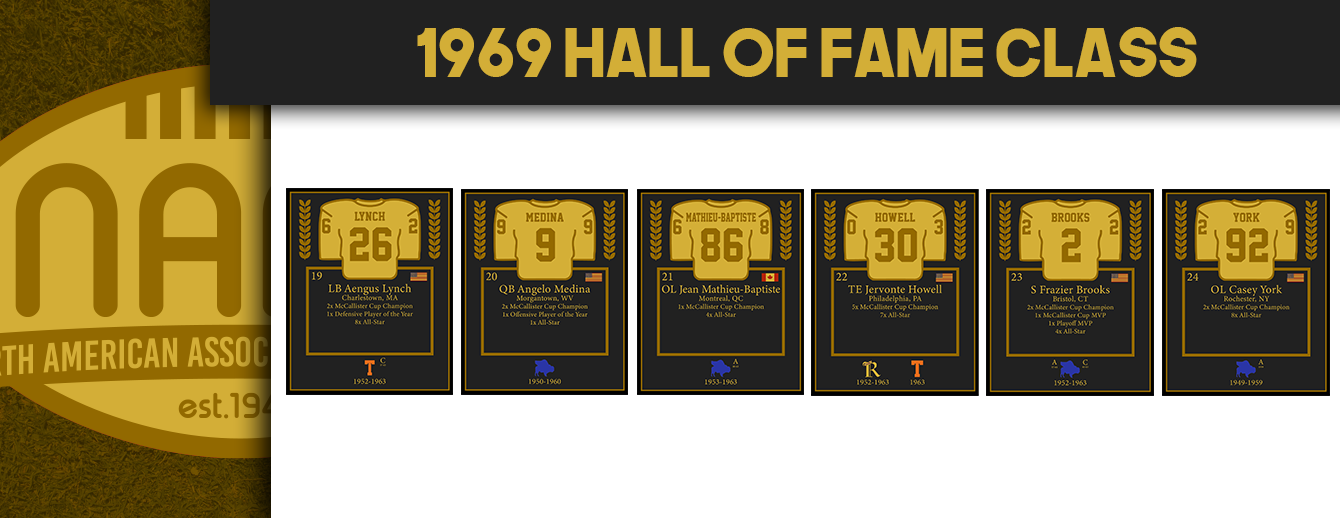
1969 Hall of Fame Class

1969 Hall of Fame Class


Member #19: LB Aengus Lynch - Charlestown, MA - Votes: 11 of 11
To kick off the 1969 Hybrid Football Hall of Fame Class, we have our first unanimously selected player. Lynch was a member of the league’s first-ever draft class in 1952, being selected 4th overall by the then Toronto Tigers. It took a couple of years for Lynch to get comfortable in the league, but by his 3rd season, Lynch was a consistent All-Star, as he would be named an All-Star in every season from 1954 to 1961. He became a sturdy anchor in the middle of the Tigers’ defence for many years, eventually winning a Defensive Player of the Year award during the 1956 season. The following year, Lynch would be named the team’s first-ever captain, a title he would hold onto until he retired after the 1963 season. On the field, Lynch helped the Tigers to rise up from being one of the worst teams in the league’s history to a constant contender, winning 2 McCallister Cups as they made it to the big game in 4 of 5 seasons between 1959 and 1963. Lynch would call it a career after winning his second McCallister cup in 1963 and will go down as one of the best linebackers of his generation, probably only second to the great Scotty Williams.

Credits to Creator: Darknes. Lynch also becomes the first community-created player to be inducted into the Hall of Fame. Lynch was one of the first players I had ever received and it is very cool to now be far along enough in the project to really close out the career of a great player (although Lynch is still working on that coaching career with the Royals).

Member #20: QB Angelo Medina - Morgantown, WV - Votes: 6 of 11 - 2nd Ballot
On his second attempt, Medina gets into the Hall. Medina will be credited to be one of the first modern dual-threat QBs. He often was able to make plays happen on his feet while also still being able to deliver the ball effectively with his arm. Medina’s professional career began with the Pittsburgh Hammers where he took over for the legendary QB William Braddock. However, Medina’s career with the Hammers didn’t last long as he would leave the team following the 1949 season. He would take a gamble and sign with the Buffalo Blue Wings of the NAAF and would take over as the team’s starting QB. His first season saw him adjust to the new game, but by year 2 he was able to get the Blue Wings into the playoffs for the first time. In his 3rd season, after a tough 0-3 start, Medina would lead the Blue Wings on a 6-1 run which propelled them into the postseason. After topping the Royals in the semi-Finals, Medina would lift the Blue Wings over the Independents to claim the team’s first-ever championship of any kind. Medina would also take home the Offensive Player of the Year award that season. Medina continued to keep the Blue Wings at the top of the league over the next several seasons, however, a few injuries did harm his overall performance. The Blue Wings would not return to the McCallister Cup in any of the next 4 seasons. In 1957, most were writing the Blue Wings off as Medina was not the same QB he used to be, but he proved everyone wrong again by helping Buffalo bounce back to a 10-2 season. Medina would lead them to back-to-back playoff wins to earn his second title. After the ‘57 season, Medina’s play continued to fall as he was not able to be the mobile QB he once was and eventually retired after the 1960 season. 


Medina was one of the first players I tried to bring in from another competing league and it was great to see how he took over the Blue Wings. Reflecting on it, I do wish I had more of those types of moves, but y’know with all the players I deal with sometimes it is just easier to manage without that, but something I would think to add if I did it again or in the future. 

Member #21: OL Jean Mathieu-Baptiste - Montreal, QC - Votes: 6 of 11 - 
1st Ballot
Mathieu-Baptiste joins Lynch as another first-ballot Hall of Famer. The Montreal native was drafted 8th overall in the 1953 draft out of Majeure Montreal. He immediately made an impact on the Blue Wings’ O-line becoming a prolific blocker for many seasons. He would make his first All-Star appearance in 1957 and would be an All-Star in each season following up until 1960. Prior to that final All-Star season, Mathieu-Baptiste was named Alternate Captain of the team. He would wear the “A” for the remainder of his career, retiring after the 1963 season. He would only be with the Blue Wings for one of their McCallister Cups in 1957.

Credits to Creator: Darknes. It’s hard to have much to say about O-lineman unfortunately, but I always remembered Mathieu-Baptiste mostly because of his name. He was successful overall, however, he unfortunately just barely missed out on having 3 McCallister Cups, having been drafted the year after Buffalo won in 1952 and retiring the year before they would win in 1964. 

Member #22: TE Jervonte Howell - Philadelphia, PA - Votes: 5 of 11 - 1st Ballot
Howell will certainly go down as one of the best tight ends in the league’s history. He was drafted in the 2nd round of the 1952 draft by the Ottawa Royals. He would work his way into the starting job and become a sturdy blocker and pass catcher for the Royals. In his 3rd season, Howell would be named to the All-Star team for the first time. He would continue to make the All-Star team in each season up until 1958. He missed out on the 1959 All-Star team, but was back on the list in 1960 and 1961, bringing his total to 7 All-Star seasons over his 12 seasons in his career. In terms of team success, Howell and the Royals were the best of the best. He won 4 McCallister Cups with Ottawa being a major piece of their dynastic run during the 50s. However, he would continue to add to that total when he was traded to the London Tigers in his final season. That year, the Tigers would win their second title and make Howell the first NAAF player to have 5 McCallister Cups in his career. 

Howell and many other tight ends often fall into the background in this series mostly due to the fact that I just don’t have offences utilizing them as much. However, I always knew that Howell was going to go down as one of the best. Especially after he became the first with 5 Cups in his career. 

Member #23: S Frazier Brooks - Bristol, CT - Votes: 5 of 11 - 1st Ballot
Brooks was easily one of the smartest players coming out of the 1952 NAAF Draft. His high intelligence served him well throughout his career becoming a steller Safety for 12 years with the Buffalo Blue Wings, who selected him 6th overall. Brooks made an immediate impact being on the field a decent amount in his rookie season which would end with a Blue Wings championship. He continued to develop into a star by being an All-Star in just his second season. Brooks wouldn’t return to the All-Star team until 1957, but he would be on the team for the next 2 seasons following in ‘58 and ‘59. 1957, however, might have been the highlight of Brooks’ career, as he was named an alternate captain at the start of the season and then helped the Blue Wings to a 10-2 season before having a pair of unreal games in the playoffs to win both the Playoff MVP and McCallister Cup MVP as the Blue Wings won their second title. In 1961, Brooks would be named the team captain after the retirement of fellow Hall of Famer, DL Sean Bowen. Brooks would remain captain until he would finally call it a career following the 1963 season. 

Credits to Creator: Captain Mort 3D. I got to give a shoutout to Captain Mort who was the user to give me the idea for the whole player submission system. Brooks was one of their first and he was one of my favourites initially. I am glad to see him get into the Hall after all this time.

Member #24: OL Casey York - Rochester, NY - Votes: 5 of 11 
- 2nd Ballot
To round out the class, we have another Buffalo Blue Wing. OL Casey York was a member of the Blue Wings for 2 seasons prior to joining the NAAF. By the time the team joined the new league, York was becoming one of the strongest young offensive linemen in the league. Over his 13-year professional career (11-year in the NAAF), York was an anchor on the line that rarely showed weakness. From 1950 to 1957, York was an All-Star, tallying 8 All-Star seasons over his 11 years in the NAAF. He was a big part of both of the Blue Wings’ first two McCallister Cups and will easily be remembered as one of the best to do it at the position. 

Oh boy, another Blue Wing. That makes 7 Blue Wings' primary players in the Hall of Fame. The next closest teams are Boston and Providence with 4 each. I was kinda surprised that York didn’t get more consideration considering his high All-Star to seasons played ratio of 8 to 11. But I also understand he suffers from being an O-lineman from early in the project. Either way, I am happy with this group of Hall of Fame Inductees, and thanks to everyone who voted!


Sunday, 19 June 2022

1968 Hall of Fame Class

1968 Hall of Fame Class

As training camps were getting underway, the 1968 Hybrid Football Hall of Fame class was announced. 6 new members would be joining the original 12 members. So without further adieu here is the class of 1968.

Member #13: QB Bruce Woodard - Providence, RI - Votes: 6 of 11
Woodard’s career began with the Providence Gold Stars in 1939. He was the backup QB for a season before he took over as the starting QB in 1940. He would lead the Gold Stars to a New England Championship in 1941, after winning as a backup in 1939. Unfortunately, his career was interrupted by the USA’s involvement in World War 2. However, once he returned to the field he would lead the Gold Stars to 3 straight championship appearances. However, he was unable to beat Boston in all 3 games. He made the shift to hybrid football in 1949, where he was able to get back to the championship again, but still fell to the Independents in the final. After a couple of early ends to the season, Woodard would have a career year in 1953, leading the Gold Stars to their best NAAF season to date and earning his lone MVP. Despite the great season, Providence fell short in the McCallister Cup again. He would only play one more year with his hometown team before they let him walk to make room for the younger QB Connor O’Rourke. Woodard would land in Ottawa as the backup to QB Jean Matieau. He would only play one game for the Royals, but he earned player of the week in that final game of the season. He would get his 3rd Cup win as the backup for the Royals later that season. The next season, he would play for the Rouge where he would make several starts but was eventually sat in favour of the younger QB Rigobert St-Hilaire. Woodard would call it a career after that as one of the league's first star QBs. 


Member #14: RB Arthur Conner - Buffalo, NY - Votes: 5 of 11
Conner was a bright star in the Blue Wings' offence throughout the 1950s. In the early years of the NAAF, Conner was often overshadowed by the play of RB Élisée Marchal and RB Joel Bonner. He would finally make his mark on the league in the 1952 season, helping the Blue Wings to secure their first McCallister Cup title, rushing for 146 yards and a touchdown, earning him McCallister Cup MVP and Playoff MVP. Following the ‘52 season, Conner became a staple at the top of the rushing categories for the next 6 seasons. In that time, he would win both of his Offensive Player of the Year Awards (1955, 1957), and have 3 of his 4 All-Star seasons. In 1957, he would win his second McCallister Cup with Buffalo after being named an alternate captain. He would play just one last season before calling it a career. Conner, on top of his excellent play, was a very kind person who many teammates loved. In retirement, he continues to give back to the city of Buffalo helping many of the less fortunate.


Member #15: WR Peter Brooks - Taunton, MA - Votes: 5 of 11
While Brooks never got the individual accolades that most of his Hall of Fame counterparts did, he was still an excellent player throughout his career. Early in his career, he would rise to the top of the Gold Stars’ receiving core, ultimately leading to the team trading veteran WR Eugene Burns, and become the team’s #1 target. He developed great chemistry with both QB Bruce Woodard and later QB Connor O’Rourke and was the only WR that was able to hold his own against the Royals’ WR Allen Atkins. Unfortunately, Brooks was never able to win a championship with the Gold Stars through 10 seasons with the club. He would go cup-hunting with a new team in 1959, signing with the Long Island Raiders. He was unsuccessful in the venture and retired after the 1960 season. Brooks was an excellent WR and will likely be one of the best players to never win the Cup. 


Member #16: DB Oscar Patterson - Buffalo, NY - Votes: 5 of 11
Patterson’s career in the NAAF was not a very long one, having spent more seasons in the NYFL with Buffalo. Patterson spent his entire career with the Blue Wings through both leagues and was easily a fan-favourite. His fun-loving personality helped him connect with fans, often seen interacting with them hours after a game. He made his mark on the NAAF in the 1952 season, when he famously painted a pair of white wings on his usually all-blue helmet. In the ensuing game, Patterson would have 2 interceptions, including a pick-6 to get a huge win over Montreal. The rest of the team started following suit adding wings to their own helmets. The look became a bit of a superstition as the Blue Wings would not lose another game en route to their first-ever McCallister Cup. The helmet design would stick and inspire other teams to add logos/designs to their helmets the following season. Patterson’s legacy was strong with his play, but he is also honoured for his revolutionary idea. 


Member #17: RB Laurent Brazeau - Montreal, QC - Votes: 5 of 11
Brazeau entered the NAAF as a complete underdog. He had a strong season in 1949 with a Quebec City-based amateur team. The performance caught the eye of Joseph Johnson, the GM/Head Coach of the Toronto Tigers. Johnson brought Brazeau on and the power back instantly became a star for the team. He would win Rookie of the Year in the 1950 season, helping the Tigers improve on their 0-8 ‘49 season. The very next year, he would win the Offensive Player of the Year Award. The league finally started to catch up with Brazeau, but he continued to be a strong force for the Tigers over the next 4 and a half seasons. In 1956, Brazeau would be traded to the Providence Gold Stars as the Tigers went to retool. Brazeau would help the Gold Stars into the playoffs and would score in his only career playoff game. Following the ‘56 season, Brazeau would be drafted by the Indiana Victors in the 1957 Expansion Draft. He would spend his final 2 seasons with the Victors being reunited with his Tigers’ QB Duane Logan and being named Alternate Captain. Brazeau was unable to have much team success, but he was still a very strong player in his own right. 


Member #18: HC/GM Guy Clarke - Montreal, QC - Votes: 5 of 11
Clarke was the Head Coach and General Manager of the Montreal Rouge for what seemed like forever. His brutal, bone-crushing defences dominated Quebec football for many years. It was that defence that helped give the Rouge their name, based on their reputation of having opponents bleeding after their games. His defensive mind carried over into the NAAF where he continued to make the Rouge one of the toughest teams to play against. Clarke’s schemes would be the first to stop the Boston Independents, ending their historically long win-streak in the NAAF’s first season. Clarke and HOF HC Peter McDuffin duelled it out over the early years of the NAAF, meeting in the McCallister Cup 2 times. In 1951, Clarke would lead the Rouge to the first and only unbeaten NAAF season. They would go 9-0-1 in the regular season before winning back-to-back playoff games to win the McCallister Cup. 2 years later, the Rouge would be back in the McCallister Cup where the defence would shut down QB Bruce Woodard and the Gold Stars to upset them in Providence. Clarke would slowly lose interest in the team after the age started to show following their second McCallister Cup win. He would finally step away from the team after a rough 1955 season, ending a long and memorable career. 


Thursday, 2 June 2022

1968 Hall of Fame Class Vote

1968 Hall of Fame Class Vote

Hey everyone, time for you to have a say in who shall be inducted into the NAAF this offseason. 

So here is how it works:
- You will get to pick up to 8 players to vote into the Hall of Fame.
- The top 5 most voted for will automatically be voted in, however, more may make it if they get enough votes.
- I may add a 6th member of my choosing especially if I feel a player deserves getting in that doesn’t get the vote.

The link to the vote form is below. A google sheet link is at the top. That sheet includes the list of current Hall of Famers, and then a sheet of eligible players. The list looks similar to the retirement sheet with all the same information. I have also included their retirement blurb to get a better idea about the player, though you may need to scroll through it. You can use that information to help decide which players you wish to vote for. 

In terms of which players I have made eligible. I had the stipulation that a player had to either win an award or be an All-Star at some point as well as be retired for at least 5 seasons. Also with All-Stars note that some positions are easier to get an All-Star, like OL where there are 10 All-Stars each year versus RB and QB where there are only 2 each. So a RB or QB with multiple All-Stars is quite impressive.

Either way, I hope you have fun voting and we will see how this all shakes out.

Tuesday, 26 April 2022

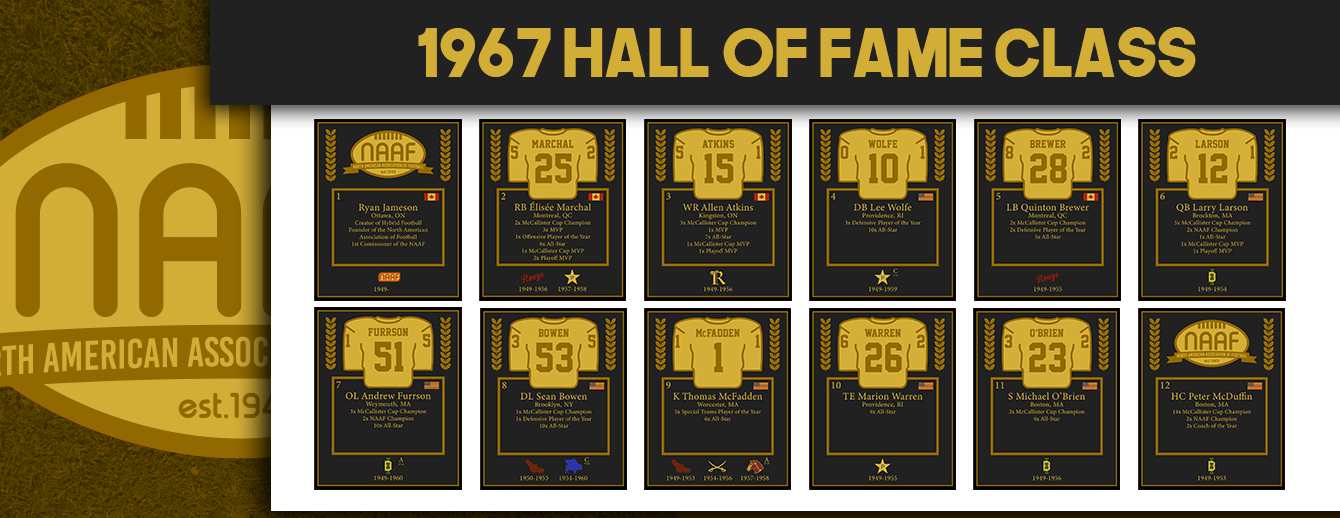
1967 Hall of Fame Class

1967 Hall of Fame Class

September 28, 1967

Hybrid Football Hall of Fame - Lansdowne Park - Ottawa, Ontario 

It was a beautiful Thursday Evening in Ottawa as a crowd full of current and former players and coaches, and NAAF owners and executives, along with their families, gathered in the brand new Hybrid Football Hall of Fame building. Commissioner Ryan Jameson would soon take the stand to begin the first Hall of Fame ceremony in the NAAF’s history. 

Jameson would get on stage next to several other key members of the NAAF, like Harold McCallister, the former commissioner of the NEFC, and son of John McCallister, the namesake of the trophy, and Larry Larson, the current leader of the NAAF’s player committee. Jameson would step forward to the stand to begin the ceremony.

Jameson: “Hello everyone, welcome to this outstanding new building we have here. I am very excited for tonight’s event. I have been very excited to have the opportunity to honour the hard working members of the NAAF, especially the players, coaches, and owners who have helped to make this league a premier football competition. Thank you to everyone who was able to be here today, but also thank you to those who were unable to be here. 

Alright, I will not stall too much more. Today we are planning to induct the inaugural class to the Hybrid Football Hall of Fame. 11 members will have their name called today, and will be honoured with a jacket as well as their own plaque that will remain in the hall in their honour. They will gain a spot in this building where we will maintain the plaque along with memorabilia and artifacts that highlight the player’s career.

Okay, let's get started. Now on my left, to your right, you will notice a curtain-covered wall there. I have not seen what is there, but I have been informed that the wall will be the highlight, and the first thing people will see when they enter the hall. So, it is fitting that the first item to be revealed would be this piece of the Hybrid Football Hall of Fame.”

The curtain was pulled off and the wall was revealed. Jameson was awestruck, not saying anything. The crowd looked at the wall and then saw Jameson’s reaction. They began to clap and cheer. Larry Larson stepped to the stand and spoke into the mic.

Larson: “Hey, Ryan. This is a thank you to you. I had worked with the architects to make sure that the first thing that people would see as they entered the building would be the man that made this all happen. You are also the first member of the Hall of Fame.”

Larson turned toward the rest of the crowd:
“Ryan Jameson came to the NEFC with the proposal of a new league and a new version of football. While his proposal had fallen on many deaf ears, Harold here, listened. It soon led to myself and Ryan meeting. When I spoke to him, I saw the passion, the drive. I saw that this was a man who wanted to take on a challenge and was going to have the guts to go up against the established leagues and rules. By the end of our first meeting, I was sold. Soon enough I was taking my first snaps in the NAAF here at Lansdowne Park in Ottawa. Since the founding of the league, Jameson has continued to grow hybrid football, grow the NAAF, and stand strong against the many competitors that we go up against. The owners, players, coaches, and all members of the NAAF, have so much respect for you, for everything you have done. No one questioned me when I told them about this. They knew this was the right choice. The sport and league would not be here without you. Welcome to the Hybrid Football Hall of Fame, commissioner, and friend, Ryan Jameson.”

It took a few moments for Jameson to take in the honour, especially when Larson gave him his jacket. Once he recovered and the crowd settled, he continued with the ceremony.

Jameson: “Firstly, thank you. Thank you to everyone, this is an honour. But I’m not going to let myself be the centre of attention, let's move forward with introducing the inaugural class. 

When selecting the inaugural class, we had some boundaries to determine who would have a chance. The main one being that the player must be 5-years retired before becoming eligible. Otherwise, it came down to who made the biggest impact on the league.

As we put together the first members, we felt it was best to pick at least one player at each position to make up our first 10 players. So without further adieu, let’s get to our first player. 

This first player was one of the NAAF’s first stars. He dominated out of the backfield over the first 3 seasons. In those years, he took home the MVP in each one. As his career went on he would add an offensive player of the year in 1953. He was a superstar for his hometown Rouge for his first 8 seasons in the NAAF, however, after winning a pair of championships with Rouge, he spent two seasons in Providence to close out his career. If you have not figured it out by now, I am talking about Running Back Élisée Marchal, welcome to the Hall of Fame.

Up next, we have a local legend for those from the city of Ottawa. Over the league’s first 8 seasons, there was no real competition over who was the best wide receiver in the league. He spent his entire career with the Royals, earning 7 All-Star nods, an MVP, and of course 3 McCallister Cups. Our next inductee is none other than Wide Receiver Allen Atkins, Welcome to the Hall of Fame Allen.

Next, we will move to our first defensive player. Our next member of the Hall of Fame was the league’s first Defensive Player of the Year. He would go on to win that award 2 more times while playing all 11 seasons in Providence. He also became the team’s first captain in 1957. He was a man that struck fear into QBs around the league. Welcome to the Hall of Fame Defensive Back Lee Wolfe.

Moving on, we must touch on one of the most important positions in any defence, linebacker. The first great player at this position was a member of one of the greatest defences in the league’s history. He was a 2-time Defensive Player of the Year and was an All-Star in 5 of his 7 seasons in the league. A true leader of the Rouge defence, Linebacker Quinton Brewer, welcome to the Hall of Fame.

Alright, I know everyone is waiting for the first quarterback of the class. Okay okay. Our first quarterback of the Hall of Fame came into the league being called the greatest quarterback of all time. He only spent 6 seasons in the NAAF, but he led the Boston Independents to 5 McCallister Cups over those 6 seasons. While his on-field play was stellar, he has also made an impact off the field, being the leader of the players’ committee and continuing to work hard to make the NAAF a premier sports competition. Thank you for all your hard work, my friend, Larry Larson, welcome to the Hall of Fame.

Alright, time to move on to the men in the trenches. Starting with the offensive line. There are plenty of great players that guard the great QBs, but there is one that stands out amongst the rest. In 12 seasons in the NAAF, this lineman was a 12-time All-Star, and a 2-time champion. He spent each of his 12 seasons with the Boston Independents, serving as alternative captain for his final 4 seasons. This player, for many years, was the premier offensive lineman. Welcome to the Hall of Fame, Andrew Furrson

Well, we covered the offensive lineman, now we look to the defensive line with our youngest member of the initial class. There were many greats already at the position but the man that became the first true superstar at defensive line dominated over 11 seasons in the league. He began as a member of the Hartford Hawks, where he played 4 seasons but was eventually traded to Buffalo where he spent the remaining 7 seasons. He was able to win a championship along with a Defensive Player of the Year Award in his time with Buffalo and would eventually become the first captain. Welcome to the Hall of Fame, Sean Bowen.

Moving onto the next position, we have the position that usually sees the field the least throughout a game. Kickers are an important part of any team, but this Hartford Hawk/Long Island Raider was one of the best throughout his career. He won 5 Special Teams Player of the Year Awards, which is currently the most won by a single player. The 6-time All-Star would go on to complete his career in Louisville, earning Alternative Captain in those 2 seasons. Welcome to the Hall of Fame, Thomas McFadden.

Now probably, the toughest position to select from was tight end, as they certainly don’t get the same recognition that other positions do. However, our selection was one of the first to make an impact at the position. In 7 seasons, with the Providence Gold Stars, this player was a 4-time All-Star and a master of blocking downfield. Our first tight end is Marion Warren, welcome to the Hall of Fame. 

Okay, the last member of our first 10 players, comes from a position that fits for being the last one, the last one back for that matter, yes, we have our safety. There have been plenty of star safeties that have come up over the years, but the first star was a man who spent all 8 seasons as a member of the Boston Independents. He was a 4-time All-Star and a 2-time Champion, and probably would have been considered for a captaincy if he had not retired just before the letter system was implemented. Our 10th member is Safety Michael O’Brien, welcome to the Hall of Fame. 


The members were given their jackets and got to see their plaques up close.

Jameson: Let’s hear it for the first class of Hybrid Hall of Fame Inductees.

Okay, we are not officially done. These players have done a lot on the field. They have been the stars making the plays and winning the games, but they still didn’t do it without guidance. What would any of these players be without a teacher, a guide, a coach. So for our final member of the inaugural class, we have a legend across all versions of football. A man who dominated the football landscape for many, many years. He won a total of 14 McCallister Cups, 2 of which came in the NAAF. He has coached some of the best players ever including 3 of our inductees today. A 2-time coach of the year, and a true pioneer, we welcome to the Hall of Fame Mr. Peter McDuffin

Now, unfortunately, Mr. McDuffin, or Duffie as many called him, is no longer with us, having passed away 3 years ago. But we will leave this honour and this jacket with his family. Duffie was hard-nosed and tough, but also kind and caring, a true embodiment of a leader and teacher. On behalf of everyone in the NAAF, and the NEFC before it, thank you Duffie, and welcome to the Hall of Fame.”


McDuffin’s family came to accept the Hall of Fame jacket. It was eventually taken by McDuffin’s Great-Grandson, 9-year-old Stevie, who put on the jacket and wore it proudly. 

Jameson: “That concludes this inaugural induction ceremony. Thank you, once again, to everyone here tonight and to everyone who was unable to be here. Now, this show is over, and the Hall of Fame is now open. I hope everyone has a great rest of the night, and that we get some great football this weekend.”

There was a collective cheer one last time as the ceremony came to a close. Jameson joined the rest of the class with their plaques and his own jacket as they mingled about throughout the night. 

Hearn is out as lead Ownership Candidate in Kansas City

In the past month, Cal Hearn had become the frontrunner for ownership of the Kansas City NAAF franchise. In the past week being made more of...