Friday, 20 May 2022

1968 Staff Changes

1968 Staff Changes


Joseph Curry’s retirement left Ottawa with a hole they have not had to fill since 1954. However, everyone knew the man that would replace the league’s longest-serving head coach. Once Jean Matieau had been hired as the Offensive Coordinator right out of retirement, it seemed pretty obvious that the team was aiming to have Matieau be the eventual successor to Curry. So within a week of Curry’s retirement, the Royals introduced Matieau and the team’s 3rd Head Coach. 

Around the rest of the league, many coaches and GMs were extended. Maurice Evanson extended with the Blue Wings, GM Joseph Johnson and HC Roy Aguirre are staying with the Tigers, GM Peter Brooks and HC Garrett Boone are continuing with the Gold Stars, HC Jimmy Sargent earned a new contract with Montreal, and Toronto is bringing back GM Howard Stinton and HC Ronald Martin.

There were not many coaches being let go, but there were still some changes. The biggest being out of Halifax. The Mariners officially let go of HC Urick Wilkins, despite the 3-year extension he signed last season. The firing comes after back-to-back seasons where the team has struggled in the second half of the season, which led to the team missing the playoffs this past season despite being looked at as a championship contender. Halifax’s search for a new coach took a little more effort than the Royals’. They interviewed several candidates: their own OC Alfred Denieu and DC Phillip Little, Buffalo coordinators OC Soni Dionne and DC Steve Pallard, and a pair of free agents in Ben McMillan and Perry Powell. The finalists for the job ended up being Denieu, Dionne, and McMillan. Denieu certainly had the disadvantage over the other candidates, having not had any head coaching experience, but the Mariners still really like him as a coach. However, in the end, the Mariners would go for a coach that absolutely deserves a job in the league and has surprisingly been out of the loop for a couple of seasons, Ben McMillan. 

McMillan has quite the resume as he served as the head coach of the Independents for 6 seasons where he had a 45-25-2 regular-season record. He was able to win a championship with the team, but his continued playoff losses led to his firing in 1965. There will be questions about whether or not McMillan can get the team success in the postseason, but they need to get there first, which their previous coach was unable to do.

Urick Wilkins would not stay unemployed for long as a spot would open up in a dramatic fashion in Indiana. Johnathan Fox has been one of the most controversial coaches in the NAAF over the past couple of seasons. Fox joined the NAAF as a well-known college coach as the DC of the Victors. After just one season, Fox was hired as the Head Coach of the Independents. Fox’s season with Boston was brutal and he would be fired after having several outbursts with his coordinators and posting a horrid 2-10 season. He returned to Indiana, but this season did not go as smoothly as his first. Over the first half of the season, Fox and HC Dannell Willis reportedly continuously butted heads which did not help the Victors during their 1-5 start. Eventually, Willis cut down on Fox’s contributions as the team rolled back to 6-6. Fox quit immediately after the season where he said he would not return to the NAAF. Within a few days of Wilkins’ firing, the Victors would announce the former Mariners’ coach as their new Defensive Coordinator. Wilkins does have an old connection to Dannell Willis, as he was his Defensive Coordinator in Buffalo during the late 1950s.

The remainder of coaches stayed put, leaving Jean Matieau to fill his Offensive Coordinator role. As he began his search, he would find out he also needed a Defensive Coordinator as Matthew Carson decided to take a head coaching role in college after 9 seasons with the Royals. Matieau personally thanked Carson, a coach he worked with over all 9 of those seasons and wished him the best of luck in his new endeavours. 

Matieau refocused on the job at hand and quickly began interviewing for the roles. He ended up interviewing 7 coaches for the Offensive Coordinator role. Those coaches were former NAAF Head Coaches Perry Powell and Dean Parrish, former NAAF Offensive Coordinators Kent Winters, Theodore Ortiz, and Wayne Ball, and finally a pair of former players, Johnnie Stafford and Jean Mathieu-Baptiste. Overall, Matieau was looking more for a coach that would be able to focus more on the development of players, while Matieau himself would be focused on the play-calling and strategy. That cut a few out of the mix, but the finalists became Ortiz, Stafford, Ball, and Mathieu-Baptiste. After deliberation, Matieau finally went with Wayne Ball. Ball had previously spent a couple of seasons with the Halifax Mariners in 1963 and 1964, where he helped a struggling QB Caldwell Higgins III to easily one of his best seasons. Ball should provide a good level of development for younger players and be able to support Matieau’s offensive game-plan. 

As for the defensive spot, there would only be 5 coaches interviewed. Those coaches are former NAAF Defensive Coordinator Jerome Morris, a younger college coach in Colton Forrest, and 3 former players in Olaf Viktorsson, Aengus Lynch, and Frazier Brooks. With the rumours of Viktorsson being interviewed, the rumblings that Matieau’s former teammate had the job locked down started to spread. However, the world would be shocked when former London Tiger, Aengus Lynch was named the Defensive Coordinator. Lynch was known for being a general on the field, directing the Tigers’ defence over his long career with the team. Matieau saw that as the key difference-maker in the decision and hopes that Lynch can translate that ability to a building a great defensive strategy with one of the best young defences in the league.  

“Look, I love Olaf just as much as everyone, but I have to make the best decision for this team, and I felt that Aengus brought that extra element to the team,” said Matieau in response to some of the outrage that he didn’t give Viktorsson the job. Of course, this was before the public found out that he had hired Viktorsson as a Defensive Development Coach.  

TL;DR

HALIFAX
OUT
HC Urick Wilkins
IN
HC Ben McMillan - from Rhode Island State University (previously BOS)

INDIANA
OUT
DC Johnathan Fox
IN
DC Urick Wilkins - from HFX HC

OTTAWA
OUT
HC Joseph Curry
DC Matthew Carson
IN
HC Jean Matieau - from OTT OC
OC Wayne Ball - from Haynes University (previously HFX)
DC Aengus Lynch - former LDN Tiger

Wednesday, 18 May 2022

1968 Brand Changes

1968 Brand Changes


TORONTO STEELHEADS

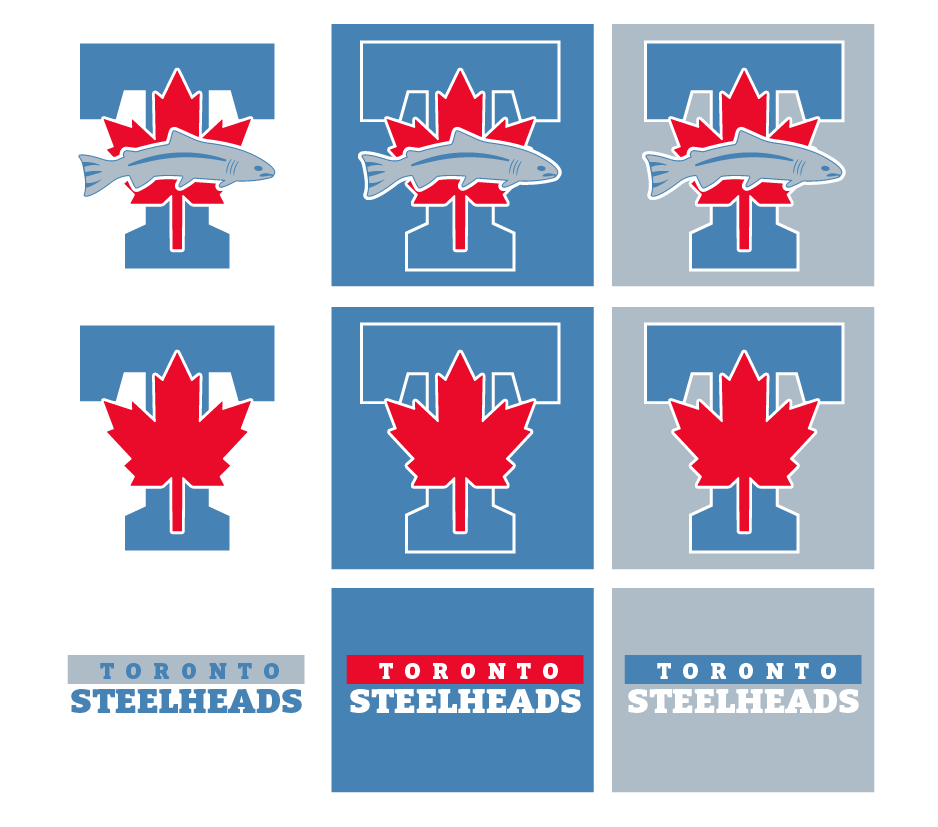
Last season, as part of Canada’s centennial celebration, each Canadian team had added the centennial logo to their jerseys for the season. Steelheads’ owner, Jerry Anderson, loved the leaf so much, that he wanted to make it a part of the uniform full time. Of course, they couldn’t just use the centennial logo, so a leaf based on one of the rejected Canadian flags from 1965 was added to the sleeves of the jerseys. Now that would not be the only change. The primary logo got a refresh with the leaf being added in between the fish and the “T”. The style of the ”T” was changed to be bolder, and the smaller details of the steelhead were adjusted with the update. 

The new logo appears as the first helmet logo for the team, although without the steelhead. As for the Jerseys, the maple leaf was added to both sleeves of the home and away jerseys, the silver numbers on the home jersey were changed to white for greater contrast, and the double silver stripe was changed to a silver stripe and white stripe on the home jersey. 

Another notable change is that the Hamilton Steelers Alternate jersey will no longer be worn by the team as they will move forward with just two jerseys next season. 


BOSTON INDEPENDENTS

Along with the 50th McCallister Cup, Boston will also be celebrating their 50th season of competition. They will celebrate this with an anniversary patch on the right side of the chest. The patch is similar to that of the Royals and Gold Stars before that with a 50 mixed with an element in their logo. For Boston, this was their “I” within the logo, but they also added “B.F.C” to the “I” which stands for the team’s original name “The Boston Football Club”. 


Tuesday, 17 May 2022

1968 Retirements

1968 Retirements


HC Joseph Curry - Oshawa, ON
Teams/Positions: OC Ottawa Royals (1952-1953), HC Ottawa Royals (1954-1967)
McCallister Cups: 4 (1954, 1955, 1956, 1959)
Awards: Coach of the Year (1958)
Regular Season Record: 94-62-6
Playoff Record: 14-5

Curry is easily one of the greatest coaches in the NAAF’s history. He joined the Royals back in 1952 as the offensive coordinator, the same season Jean Matieau took over as starting QB. After just 2 seasons, HC Otis Ward stepped away from the head coaching role and promoted Curry. In Curry’s first 7 seasons as a head coach, he took the Royals to the McCallister Cup in each and every one of them, taking home 4 Cups in those years and having an overall record (regular season and playoffs) of 72-19-3. He won his lone Coach of the Year Award in 1958 after leading the Royals to the only perfect 12-0 regular season, however, he probably should have won more Coach of the Years considering his resume. After those first 7 seasons, the Royals fell into old age and Curry certainly was not as dominant, but still managed to never win less than 4 games in a season once in his career. Curry is a legend, there’s no doubt about that.

DB Alexander Bradley - Newark, NJ - Creator: Captain Mort 3D
Drafted: 1954 WOR - Round 1, Pick 2
Teams: Worcester Athletics (1954-1958), Louisville Thunder (1959-1963), Long Island Raiders (1964-1967)
McCallister Cups: 2 (1962, 1965)
Captaincy: LOU - A (1959-1963)
Awards: Rookie of the Year (1954), Defensive Player of the Year (1959)
All-Stars: 11 (1954-1957, 1958-1962, 1964-1966)
Player of the Week: 7

Bradley has been a superstar DB for almost his entire career. He burst onto the scene in Worcester, taking home Rookie of the Year after being selected with the 2nd overall selection in the 1954 draft. He was a part of a talented Worcester team that went to the McCallister Cup in 1956. However, following the run, Bradley butted heads with the ownership and was low-balled over a new contract with the team. He then decided to move on from the organization and signed with an up-and-coming Louisville Thunder squad. He became a star on the young team, winning Defensive Player of the Year in his first season. He would eventually be paired up with Oliver Langstrom, Jayden Mills, and Johnny Berger to create one of the scariest secondaries the league has ever seen. That crew helped the Thunder to their 1962 McCallister Cup win. After just one more season with the Thunder, Bradley would move on once again and head close to home, signing with the Raiders. He would help to give Long Island easily one of, if not the best defences in the league. In his 4 years with the team, they would head to the McCallister Cup 3 times, coming away with one win. Bradley always seemed to not only dominate himself, but made those around him better. He was a leader, not in a vocal way, but in the way he played. Bradley is unsure of what he will do next, but coaching might be right up his alley. 

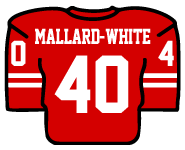
RB Scott Mallard-White - Oshawa, ON - Creator: ThisIsFine
Drafted: 1956 - MTL - Round 1, Pick 1
Teams: Montreal Rouge (1956-1967)
McCallister Cups: 0
Captaincy: MTL - A (1963-1966)
Awards: 2x Offensive Player of the Year (1958, 1963), Playoff MVP (1962)
All-Stars: 5 (1958-1960, 1962, 1963)
Player of the Week: 10

Mallard-White had a lot to live up to when he was taken first overall by the Rouge back in 1956. Not only did he need to prove that he was worth a #1 pick, but also that he had to eventually fill the shoes of HOF RB Élisée Marchal. You can say that he did that very well, taking home his first Offensive Player of the Year in just his 3rd season, 2nd as the full-time starter. He continued to be a huge piece of the Rouge offence over many seasons, eventually winning his second OPOY in 1963, one season after a stellar playoff performance that took the team to their first McCallister Cup appearance since 1953. Mallard-White was a hard-working player throughout his career, always keeping his head down and pushing to be the best. He would eventually be an alternate captain for 4 seasons while helping Montreal reach another McCallister Cup in 1966. 

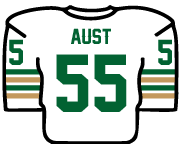
LB Konrad Aust - Staten Island, NY - Creator: ZO82
Drafted: 1956 - BOS - Round 1, Pick 2
Teams: Boston Independents (1956-1967)
McCallister Cups: 1 (1961)
All-Stars: 9 (1957-1960, 1962-1966)
Player of the Week: 6

For the longest time, the Independents had a dynamic duo in their LB core with Konrad Aust and Brent Harper. Harper was the leader and the one with all the techniques and Aust was the highly skilled guy that created mind-blowing plays. Throughout his career, Aust made some pushes as a dark horse in the Defensive Player of the Year conversation, however, he never came away with the award. He did, however, have 9 All-Star seasons starting in just his second season in the league. Aust ended up playing his entire career with Boston, winning 1 championship in 1961.

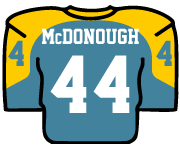
DL Calias McDonough - Brooklyn, NY - Creator: Darknes
Drafted: 1955 - PRO - Round 1, Pick 2
Teams: Providence Gold Stars (1955-1967)
McCallister Cups: 0
Captaincy: PRO - A (1959-1967)
All-Stars: 7 (1956-1962)
Player of the Week: 6

McDonough will go down as a legend among the Gold Star fans. Ever since the team took him 2nd overall, he had been a dominant force on the D-line. He had 7 All-Star seasons in his 13-year career. He spent all 13 seasons with the Gold Stars as a menace on the edge. Not only was his play on the field good, but he had a great personality. He was quick-witted and often threw around trash talk, and made many laugh with his humour. His personality fit in very well with the fanbase in Providence which easily made him a fan favourite. While he may never admit that he’s in love with the fanbase, it is very clear he loved playing in Providence, hence why he declined to get traded earlier this season. McDonough may not end up as one of the greatest DL of all time, but he will certainly be in the conversation for the greatest in Gold Stars history. 

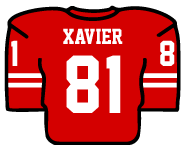
DB Quentin Xavier - Dorchester, MA - Creator: Darknes
Drafted: 1955 - MTL - Round 1, Pick 3
Teams: Montreal Rouge (1955-1967)
McCallister Cups: 0
Captaincy: MTL - A (1957-1962), MTL - C (1963-1966)
All-Stars: 6 (1956-1961)
Player of the Week: 7

Xavier burst into the NAAF as an interception machine, having around 5-7 interceptions a season during the bulk of his career. He was often in the conversation for the Defensive Player of the Year throughout his early career. While the stats and performance were amazing, his leadership is what made Xavier great. Xavier came from a rough background in his childhood, but through football, he was able to stay out of trouble. The family he gained from the sport was vital in how he grew up. That love for his teammates made him into a great leader. He took everything that he learned and became a vital leader of the Rouge throughout his career. He helped the team to reach 2 McCallister Cups in his career and would become the team’s 3rd captain in 1963 and serve for 4 seasons. Xavier’s connection to the game will not likely keep him away from the field for long, expect to see him back in the NAAF soon.

OL Magnus Gunnersson - Bar Harbor, ME - Creator: Darknes
Drafted: 1955 - WOR - Round 1, Pick 4
Teams: Worcester Athletics (1955-1957), London Tigers (1958-1967)
McCallister Cups: 2 (1960, 1963)
All-Stars: 6 (1958-1963)

Gunnersson started his career after being drafted 4th overall by the Athletics. He quickly became a vital part of the Athletics line and helped them to a McCallister Cup appearance in 1956. In his time with the Athletics, Gunnersson became very close friends with QB Riley Kiernan. When Kiernan was traded to London in 1958, Gunnersson did not appreciate the move, and after arguing with the front office he decided he would not play for them anymore and would go to join Kiernan with the Tigers. The two helped make the Tigers into one of the best teams in the league’s history over the early 60s. They won 2 McCallister Cups in that time while Gunnersson became a 6-time All-Star. Gunnersson retires after 13 seasons and will be looking for a new career to dive into.


K Johnnie Berg - Lancaster, PA - Creator: Wallflower
Drafted: 1952 - BOS - Round 2, Pick 15
Teams: Boston Independents (1952-1967)
McCallister Cups: 1 (1961)
Captaincy: BOS - A (1966)
Awards: 2x Special Teams Player of the Year (1957, 1963)
All-Stars: 5 (1957, 1960-1963)

Johnnie Berg was the first kicker to ever be selected in an NAAF draft. In the end, Boston made a good pick as Berg was consistently one of the league’s best kickers throughout his career. He would go on to play 16 seasons with Boston, winning the Special Teams Player of the Year twice and being an All-Star 5 times. Berg was overall a calm and collected guy that never seemed fazed by pressure and that was reflected in his clutch ability. He did become an alternative captain in 1966, becoming just the second kicker to wear a letter in the league behind HOF K Thomas McFadden. Berg’s plan after retirement is up in the air, but he has been known to be a pretty good griller by his teammates, so he may follow that hobby of his.

OL Maxence Castex - Gatineau, QC - Creator: ZO82
Drafted: 1955 - MTL - Round 4, Pick 29
Teams: R.Montreal Rouge (1955), Montreal Rouge (1956-1967)
McCallister Cups: 0
All-Stars: 5 (1958-1961, 1963)

Many teams passed on Castex during the 1955 draft, and they all made a mistake. Montreal on the other hand got the amazing benefit of drafting a career starting OL in the 4th round. Castex was a consistent anchor on the line over his 12 seasons with Montreal. 5 of those 12 seasons would earn him an All-Star nod. In the locker room, Castex was very quiet, but a lot of his teammates liked that about him. He seemed calm and was always a good presence on the team. It is unclear what Castex is expected to do in retirement, as well he hasn’t said anything about it, well much of anything at all.

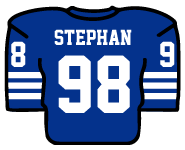
OL Georgio Stephan - Fall River, MA - Creator: ZO82
Drafted: 1956 - BUF - Round 1, Pick 6
Teams: Buffalo Blue Wings (1956-1967)
McCallister Cups: 4 (1957, 1964, 1966, 1967)
Captaincy: BUF - A (1964-1967)
All-Stars: 3 (1961-1962, 1964)

Stephan’s 12-year career was spent entirely in Buffalo. He had 3 All-Star seasons during his career before being named an alternate captain in 1964. Despite seeing his playing time dwindle over his last couple of seasons, he was still an important leader in the team’s 3 championships over the past 4 seasons. Despite being hard-nosed when it came to playing football, often getting on players who slacked off, he was still very kind, being especially involved in the Blue Wings’ community efforts outside of the game. Stephan’s career moving forward is likely as a trainer to try and help younger players achieve their dream of playing in the NAAF. 

WR Sammy Moss - Cortland, NY - Creator: Captain Mort 3D
Drafted: 1956 - PRO - Round 1, Pick 4
Teams: Providence Gold Stars (1956-1963), Louisville Thunder (1964-1965), Providence Gold Stars (1966), R.Louisville Thunder (1967)
McCallister Cups: 0
Awards: Breakout Player of the Year (1957)
All-Stars: 3 (1957, 1962, 1963)

You could say that Moss didn’t quite live up to the hype a 4th overall pick can bring, but he had a very strong career as a star WR for the Providence Gold Stars. He spent his first 8 seasons with the Gold Stars where he had led the team in touchdowns on multiple occasions and earned 3 All-Star nods. One of those seasons, where he led the team in touchdowns, was his 8th year in which he left the team in the offseason to go get paid. He got paid alright in a pretty rough overpay on the Thunder’s part as Moss was not the same WR after signing that contract. He only caught 6 touchdowns over the two seasons with Louisville, compared to 9 he scored in the season before. Moss returned to Providence after the deal, but saw minimal snaps, and would finish his career in a return to Louisville where he sat on the reserve list for the season. Despite the rough end to his career, Moss was still a strong WR for the Gold Stars and should still get recognition for his play. 

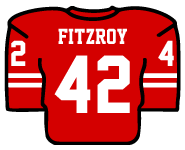
LB Sam Fitzroy - Loudon, NH - Creator: DireBear
Drafted: 1957 - MTL - Round 1, Pick 4
Teams: Montreal Rouge (1957-1967)
McCallister Cups: 0
Captaincy: MTL - A (1960-1966)
All-Stars: 2 (1963, 1965)

Fitzroy was not quite a star, but always was a steady player in the Rouge LB core. Similar to Moss, he didn’t quite reach the high-end level that some hoped for from a 4th overall pick. However, Fitzroy still brought 4th overall pick value in his leadership, which gave him an “A” for 7 seasons, and smarts on the field. He became the perfect player to lead the Jimmy Sargent defence which was more calculated and required the defence to play as a unit. He still ended his 11-year career with 2 All-Star seasons but was unable to win the McCallister Cup.

RB Stavros Black - Gary, IN - Creator: Dan O’Mac
Drafted: 1957 - LOU - Round 2, Pick 20
Teams: Louisville Thunder (1957-1961), The Athletics/Halifax Mariners (1962-1964), Pittsburgh Blacksmiths (1965-1967), Halifax Mariners (1968)
McCallister Cups: 0
Captaincy: HFX - A (1962-1964), PIT - C (1965-1967)

Stavros Black was never a superstar RB in the NAAF, but the guy continuously was a starting RB throughout his career. He worked his way up from a 2nd round pick to become the starter in Louisville for several seasons. However, that changed when he was dealt to The Athletics in the infamous Scotty Williams deal. With his new team, Stavros became a leader and would become an alternate captain and a steady presence in the backfield. After 2 more seasons following the move to Halifax, Stavros would get picked up in the Pittsburgh expansion draft. He would be named the first and only captain of the Blacksmiths and become the starter over the first 2 seasons. While he sat back as a backup in his final season, he would return to Halifax in search of a title, but came up short. Stavros is expecting to retire and stay in Halifax but might be open to coaching down the line.

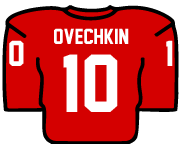
QB Stanislav Ovechkin - Brooklyn, NY - Creator: ZO82
Drafted: 1954 - LI - Round 4, Pick 25
Teams: R.Long Island Hawks/Raiders (1954-1955), Long Island Raiders (1956), Montreal Rouge (1957-1960), Buffalo Blue Wings (1961), Louisville Thunder (1962-1965), Indiana Victors (1966), Buffalo Blue Wings (1967)
Captaincy: MTL - C (1957-1960)
McCallister Cups: 2 (1962, 1967)
Awards: Breakout Player of the Week (1958)
Player of the Week: 1

Ovechkin made quite the career out of a late-round pick. After he was picked in the 4th round by Long Island in 1954, Ovechkin would spend his first 2 seasons on the reserve list. He put in the work over those two seasons and made it as the backup to Lyle Painter in 1956. Painter would get hurt during the season allowing Ovechkin to show what he had led the Raiders to a 2-2 record over his 4 starts. Montreal liked what they saw and traded for Ovechkin, signed him to a 4-year deal, and named him captain. Ovechkin would serve as the Rouge starter over those 4 seasons. He would win the Breakout Player of the Year award in 1958, but his first 3 seasons as the starter were not spectacular, but he did lead the team to the playoffs in his final year of the contract. Unfortunately, GM Virgil Gross had his eyes on Gene Bishop, so Ovechkin would be released and would sign with Buffalo. He started the first half of the season before Charles Lemieux was handed the reins. After that, Ovechkin was traded to Louisville where he was a part of the ‘62 championship team and started the majority of the ‘63 season after Leonidas Dumont was injured. He continued as a backup for Louisville, Indiana, and Buffalo over his last 4 seasons. He retires a champion with Buffalo ending a pretty respectable career for a 4th round QB.

Other Notable Retirements
DL Robin Hill - Burlington, VT - Creator: Thehealthiestscratch - Drafted: 1956 - BOS R1: P5
Teams: BOS (1956-1965)*, MTL (1966-1967)
S Drew Porter - Baltimore, MD - Creator: Captain Mort 3D - Drafted: 1956 - ON R2: P11
Teams: R.ON (1956), ON (1957), BOS (1958-1965)*, IND (1966-1967)
RB Kendall Morgan - Frankfort, KY - Creator: MyTeamIsDr.Pepper - Drafted: 1957 - BOS R1: P3
Teams: BOS (1957-1966, 1967)*, LI (1966)
WR Ben Roland - Williamsport, PA - Creator: DireBear - Drafted: 1957 - OTT R1: P10
Teams: OTT (1957-1958), LOU (1958-1963)*, PRO (1964), TOR (1965-1967)
LB Wilson Rockwood-Barnes - Creator: MyTeamIsDr.Pepper - Drafted: 1957 - ON R1: P7
Teams: ON/LDN (1957-1962)*, IND (1963-1964), MTL (1964-1966), PRO (1967), OTT (1967)
LB Killian Reed - Boston, MA - Creator: Dan O’Mac - Drafted: 1957 - OTT R3: P30
Teams: OTT (1957-1963)*, BOS (1964, 1966-1967), PIT (1965), BUF (1967)*

Sunday, 15 May 2022

1968 League Meetings Summary

1968 League Meetings Summary


Following the long week of deliberation, Ryan Jameson came forth for his annual State of the League address to reveal the changes that are being put into place for the league’s new season. Here were the main points from the address.

NAAF TO EXPAND TO 14 TEAMS IN 1969

To the surprise of no one, Minneapolis was announced as the first of the two new expansion cities. The city was strongly considered to join the league back in 1965, however, Pittsburgh was awarded the team instead. Minneapolis remained on the NAAF’s radar, and despite the GLFL awarding the city a team the NAAF still came back. The team will be owned by Kris Matheson, who has shown an immense passion for football, exhausting almost every strategy to get a team. He helped get the GLFL team in the city, however, that also came with the city’s baseball owner, Harold Smith, getting the team behind his back. Matheson originally had a part with the team but was cut out following his attempts to build a new stadium, which Smith was not a fan of. Matheson is thrilled to have this opportunity and promised that he will do whatever it takes to give the fans of the team a competitive and successful team to watch. The team will be playing out of a brand new stadium at the University of Minneapolis which the NAAF helped in funding. The stadium is close to completion and they hope the university will be able to play games at their new building soon.

As for the second team, there were long conversations that occurred throughout the week that helped the league take the 6 candidates down to 2 finalists. 

Portland, ME - The first cut was Portland. Overall, the interest for a team was just not that strong and Quebec certainly had a stronger position as an Eastern expansion city at this point.

Des Moines, IA - Des Moines was the next team on the chopping block. The potential ownership’s lack of commitment to the team, as well as uncertainty over the group handling the early struggles and growth of a new team, did not make them as desirable of a location as the other options. 

Grand Rapids, MI - Grand Rapids’ latest bid for an NAAF team was certainly much better than their first back in the mid-50s, but it was not good enough to earn a new team. The uncertainty of if the city will be able to get a new stadium built and being in the heart of GLFL territory were the main points that went against the bid.

Quebec City, QC - Quebec survived to the final 3 bids, primarily because of an argument put forward about the league’s divisional alignment. Mainly, adding an eastern team alongside Minneapolis would help keep the divisions even without displacing any of the current teams. However, the prospects of the Western options won out and Quebec City would be waiting once again.

The final two cities were Omaha, NE and Kansas City, MO. Omaha seemed to have quite an early lead going into the decision day. Having a stadium ready to go and flexibility to potentially start play in the 1968 season gave the NAAF confidence and comfort over the relatively safe pick. However, that advantage became obsolete when Kris Matheson came forward to mention that he would prefer to have his Minneapolis team begin play in 1969 to make sure that everything is in place and ready to go on day 1, instead of rushing it all to completion. Omaha’s big advantage seemed to diminish as Kansas City was now more seriously considered. It became very quickly evident that Kansas City had the advantage now. Firstly, the city is almost 3-times the size of Omaha. Also, they have a proof of concept with the city already having a baseball team, which Omaha did not. Darren Lindell, co-owner of the London Tigers, would go on to put the nail in the coffin, making the point that the larger market would overall benefit the league financially. Mainly, a larger market means more money, and other teams will not have to contribute as much to revenue sharing with the smaller teams in the league. Lindell’s point would win over most of the owners and made it almost a unanimous decision that Kansas City would get the league’s 14th team. 

Jacob Cross will be the owner of the new Kansas City team. Cross is a businessman who has shot into the spotlight within agribusiness over the last few years. His ventures have led him to partner with Powell Mills to help bring the team to Kansas City. The two will help to build a new stadium on the outskirts of the city which is expected to be one of the biggest stadiums football has seen. Cross is excited to have another new opportunity which has come his way over the past decade and will do his best to give Kansas City a great team. 

Jameson did not touch too much on the plans, but it is expected that both teams will likely join the West Division with the Toronto Steelheads likely moving over to the East Division to join Ottawa and Montreal. There are also talks about the playoffs potentially expanding to 8 teams along with the expansion, but that is yet to be decided.


BYE WEEKS ARE HERE

There was a unanimous decision to add a bye week to the season, however, the decision on how the league would implement the bye week had everyone a little more split. The rolling bye weeks had a strong lead early, however, it would be the mid-season half-break that would win the vote in the end. The key reasons were, that it was the fairest system while still having football action for all 13 weeks of the season and it was the easier model to schedule. This means week 7 of the usual schedule will simply be split into two weeks with half of the teams getting a bye one week and the other half getting a bye the next week. 

EXTENSION CLAUSE UP TO $1,000

Another strong decision was made about the NAAF Players’ Extension Clause. The vote was heavily in favour of the league upping the minimum raise amount for players that are extended prior to hitting free agency to $1,000, which is up from $500. This means unless a player waives the clause, a new contract must come with a $1,000 annual salary raise if it is signed prior to the first day of free agency. 

THE COIN TOSS REMAINS

Probably the most divisive topic over the whole week was over whether the NAAF would remove the coin toss at the start of games for the 1968 season. In the end, the traditionalists seemed very against the idea and made sure the league kept the tradition. However, there were some supporters of the change, especially those making the argument to give a little added bonus to the home team while also being almost more fair considering each team would get the first choice for half of their games rather than just a level of random chance. However, it was no use as the coin toss will remain a normal tradition in the league.

ROSTER EXPANSION

Late in the week, there was a last-minute proposal that had come forward in order to allow for the league’s rosters to expand from 40 to 42 players. It’s not a big jump but teams are hoping to have a 3rd Tight End on the roster, with the rising injuries at the position. To keep the roster at a round number they added a flex spot that can be at any position at least for this season.

OTHER ANNOUNCEMENTS

The remaining announcements were basic league announcements for this season:
 - The salary cap for the 1968 season would be increased from $615,000 to $625,000. 
 - With the addition of the bye week, week 13 will occur during the week that the Division Semi-Finals normally occur, thus, the playoffs and McCallister Cup will be pushed a week later than normal.
 - The league will also have the first official Hall of Fame vote this offseason and will announce the class ahead of week 1.

ELSEWHERE…

ACFL

VAN FOSSEN OUT AS COMMISSIONER

Last offseason, the rest of the ACFL owners were close to removing Stephen Van Fossen as the commissioner of the league. However, Van Fossen talked his way out of it with a shiny new plan to continue to march into NAAF territory and expand the league to 14 teams over the next few seasons. Unfortunately for Van Fossen, the plan did not get off to a good start. He had targeted Hamilton, ON and Hartford, CT as the key markets for his plan. Unfortunately, he underestimated the sheer lack of desire from either city to bring on a team. Both cities likely needed new stadiums to be able to support teams long-term. Hamilton specifically had no interest in the American game, and neither city was very confident in the ACFL's potential for success, especially with how the Boston Shamrocks have performed since joining the league. Now, when Van Fossen had initially presented his last-minute idea, he had pushed the idea that he already had potential suitors for teams set in both cities, but it turns out it was a load of bullcrap. Once the other owners had realized that Van Fossen was completely out of his mind, they officially removed him as the league’s commissioner. 

Now their next step, of course, was to appoint a replacement. That decision was certainly an easy one as well. Don Soriano, the owner of the Philadelphia Rebels, was selected as the latest commissioner of the ACFL. Soriano has only been the owner of the Rebels for the last 5 seasons. He had come into control of the team the same year Van Fossen was made commissioner. Early on, the two seemed to get along, however, Soriano was the one that eventually started to question Van Fossen and became the primary advocate for his removal. The two created a divide in the ACFL. Initially, there were more owners on the side of the longtime owner of Van Fossen, but as the problems started to mount, more and more of the owners started to flip and back Soriano. Van Fossen’s last-ditch plan was the final nail in the coffin. Frankly, Soriano may have already known it would fail, which might be why he let Van Fossen go ahead with the plan despite advocating so harshly to remove him. In the end, everything played right into his hands.

Soriano seems to bring stability to the role, having what appears to be a more level head and less of a hyper-focus on the battle with the NAAF. So far, Soriano has made statements about focusing on the existing teams and league rather than another, which likely means the ACFL will cooldown on their attack of the Northeast and potentially retract teams from the area. However, Soriano has not made any changes as of yet and will likely take the season to figure out how to move forward with the ACFL.

GLFL

RESPONSE TO NAAF EXPANSION

With the NAAF’s latest expansion announcement, the GLFL certainly had some eyes on them regarding the decision. After all, the addition of Minneapolis means a direct competition between the Black Bears and the NAAF’s new team and Kansas City had always been looked at as one of the next steps in the GLFL’s growth. League commissioner and Chicago All-Pros owner, Larry Winfield, reassured that the NAAF’s decision was not of concern and would not affect how the GLFL moved forward. Cleveland Captains owner, Jack Attwood had said that he was concerned about the situation and wanted to make sure the league wasn’t falling just sitting by and waiting to get taken over. Winfield’s response was to have Attwood meet with him so he could reassure him that everything is going to be just fine. The older, experienced owner, Winfield, also pointed to the ACFL as an example of what he doesn’t want the GLFL to become. Winfield’s personable approach seemed to work and the situation died down as the league set in for the remainder of their own football season.

Thursday, 12 May 2022

1968 League Meetings - Part 1

1968 League Meetings - Part 1

The 1968 NAAF league meetings entered a new format this offseason. The first day or so was dedicated to members of the league, owners, players, and coaches, proposing potential changes to the league’s rules and regulations. After discussions on the topics over the week, they will be voted upon at the end to decide which rules to take into effect. (yes, that means you guys will have a chance to vote on these rules).

Here were the main proposals and news to come from the first day of meetings.

MINNEAPOLIS STADIUM UNDER CONSTRUCTION
Last offseason, the University of Minneapolis and potential football team owner Kris Matheson had put together a proposal for a new stadium at the city’s largest university. The proposal was a strong one, but still wasn’t a sure go, however with the NAAF’s help in producing some funds, the city approved the new building. Over the last year, the stadium had been under construction and should be complete for the University to play some games this season. 

At this point, it seems already set in stone that the NAAF will be adding a Minneapolis team in the near future. However, Jameson is not keen on expanding by 1 team again and would rather have a pair of teams to go forward with. Jameson is hoping to add a team that is also out west to help grow the game along with Minneapolis. However, it has been difficult to find a city with the stadium and potential to have a team, especially with the GLFL taking up most major Midwestern cities. Most proposals the league has seen, have not been all that strong. Most need to build a stadium but may not have the financial backing. The NAAF would normally step in, but they are already running a bit low following the Minneapolis deal.

However, here have been the strongest proposals

Grand Rapids, MI - Back in the 1957 expansion process, David Harrison had been looking to have football return to the city, but a new stadium was very much needed and Harrison was not willing to make it happen for an NAAF team. A decade later, and now his son Daniel Harrison is making a push for the return of football. This time, there is a greater willingness to build a new stadium to house a team, however, Daniel isn’t quite as well off as his father was, so there will certainly be a need for financial support to make it happen.

Des Moines, IA - This proposal is a long shot at this point, however, because of its proximity to Minneapolis, Des Moines has stayed in the conversation. They do have a potential ownership group led by Duncan Brown, but they are not quite as invested in getting a football team to the city. They seem to be more on the safe side and would not be willing to eat too many losses if the team does struggle. However, if it does work then it could be a very interesting spot.

Kansas City, KS/MO - Kansas City is probably the biggest market that is up for grabs at the moment. It also appears to have the best backing behind it. The potential owner Jacob Cross is hoping to bring the team to the city. Despite the city already had a baseball park, they will need a new stadium as the baseball team doesn’t want to have the field changing during the summer season. Luckily, a farming company, Powell Mills, is coming to assist Mr. Cross in helping the funding of the new stadium, however, there are still some concerns behind the overall bid with Powell Mills being a fairly young company, and not the most influential sponsor at this point. 

Omaha, NE - This bid has been a bit more under the radar, but there is a proposal to have the team play out of Major Nebraska University. Harry Colson is a Dean at the university and has a pretty cost-effective proposal, with the school’s stadium that is relatively new and able to field the NAAF’s larger field. As a whole, Omaha is not the biggest market for sure, but it still holds a candle over locations like London and Halifax, which have had success. The best part is, that this proposal could be the cheapest and could even fast-track the expansion to 1968 rather than waiting until 1969 by having the stadium ready to go.

Quebec City, QC - While a move out west is the most likely, there are still the usual suspects out East that may be able to sneak their way into the conversation if the Western markets fail. Quebec City has been a hybrid football heartland that would no doubt support a team. They do still have a good stadium, which has been used for hybrid football for many years now. The stadium is still on the smaller side, but it’s still an option, similar to Omaha, that could fast track the expansion to next season. The downside for Quebec at this point is the concern that a professional team could harm the strong semi-pro/college culture in the city which has been a major help to the development of players of the year. 

Portland, ME - Portland has always found itself in strong contention for a team, but the desire to bring a team to the city has subdued over the years from both the NAAF and the likely ownerships, mainly led by Phillip Dockson, but it remains an option in Jameson’s book. The faltering interest is likely due to the NAAF’s growth and the several failed attempts from the city in the past. This is still a location that does need a new stadium to really be able to house a team long-term. 

I won’t be having an actual vote for the expansion city, but feel free to give your feedback and thoughts, I will still take those into account when making the final decision. 

NEW RULE PROPOSALS

BYE WEEK
The players and coaches came together with a proposal to look at adding a regular bye week to the regular season. The players specifically stated that they liked the bye weeks that were present during the 1964 season when the league had an odd number of teams. They specifically noted how the game is getting faster and more dangerous, and with that comes more injuries. The hope is a week off for teams could help to give a bit more time to recover and some time to see family during the season. A majority of the voting members are in agreement to add a bye week, however, they are not sure when the week should occur. 

There are several options that were looked at which still need to be decided:

Option 1 - Mid-Season Break - The first option would be a simple break between weeks 6 and 7. This would mean there would be no games played during the week and the season would resume in week 7. 
Pros: Simple for Scheduling, Overall fair with everyone having the same week off. Plus more of the league members could take the week off as well.
Cons: Could be a tough one to pass with TV deals

Option 2 - Mid-Season Half-Break - The second option would be a similar break, except week 7 would be split into 2 weeks with half of the teams getting the first week off, and then the next week would be off for the other 6 teams. 
Pros: Still relatively fair, Still games every week, could lead to a higher watch rate with teams having the week off.
Cons: Not quite as fair as the complete break, league members will not be able to have the week off. 

Option 3 - Rolling Bye Weeks - The third option would see a rotation of 2-4 teams getting a bye week between Week 4 and Week 9. (This is similar to how the NFL does it)
Pros: Keeps the most games going throughout the season. 
Cons: Less fair, some teams have early by week while others have later weeks, tougher to schedule.

Option 4 - Trade Deadline Break - Like the first option this would be a hard break with every team getting a break, however, this time the break occurs over the trade deadline.
Pros: Fair week off and allows traded players to have more time to adjust to new teams, better to help players heal later in the season.
Cons: Could be a tough week off for those potentially getting moved instead of being a proper break.

SALARY RULE CHANGES

The NAAF currently has a rule in which a player can call for at least a $500 raise in annual salary if they are to have their contract extended prior to hitting the open market. There are some players that wish to have that raise amount increased to $1,000 for this season. It does seem like a good idea as a whole to help players be paid better, however, there are some other players that feel as though the rule could cause more of those fringe players to enter free agency more frequently and could lead to less stability which isn’t necessarily a good thing for those players. It would help if the salary cap does increase allowing teams to spend more, the new cap is yet to be determined. The existing rule rarely affects the higher paid players as they usually exceed the rise by a significant amount anyway, so there may not be very many benefits to making this change. 

REMOVAL OF COIN TOSS

There is a potential rule change that would see the removal of the traditional coin toss at the start of games. It will likely be replaced with giving the home team the first choice as if they won the coin toss. Of course, the traditionalists in the league are against a change to the classic pre-game event. However, there are just as many who wouldn't mind the change, which just adds to a team having home-field advantage.

Sunday, 8 May 2022

1967 Award Winners

1967 Award Winners


Most Valuable Player - S Garet deVale MTL
One of the closest votes yet for the MVP, but with the commissioner’s decision with the tie-breaker, Garet deVale becomes the second defensive player and the first Montreal player since RB Élisée Marchal in 1951 to win the MVP. deVale defined exactly what it means to be the most valuable player on a team, being easily one of the best secondary players in the league while playing on a fairly weak Montreal defence. His league-leading 10 interceptions and 3 defensive touchdowns were outstanding and he absolutely deserves the MVP award.

Playoff MVP - DB Rutherford Winters LI
There were 3 guys who were considered for the playoff MVP: Winters, Charles Lemieux and  Théodore Lemieux, but in the end with 3 interceptions and a forced fumble in just 2 games, Winters was the standout player in the postseason. His play throughout helped the Raiders to their win over the Gold Stars in the East Final and his interception in the McCallister Cup allowed the team to get their lone touchdown of the game. 

Offensive Player of the Year - RB Jimmy Golden BUF
Golden has continued to show he is the Running Back of his generation. Another strong season ends with Golden leading the way in rushing stats with 20 touchdowns and the most rushing yards overall. This is Golden’s first Offensive Player of the Year win, which he will add to his 3 championship rings and MVP win in 1964.

Defensive Player of the Year - LB William Washington II LI
Washington continues to be a dominant defender in the NAAF, and easily the best player on the Raiders’ defence. He took home his second Defensive Player of the Year award, after winning his first in 1965. In 1967, he did lead the league in tackles and had 7 forced fumbles to tie for the league lead.  

Special Teams Player of the Year - K Henderson Schumacher LI
Schumacher won his first STPOY Award since 1959. This is his 3rd win as the league’s best Special Teams player. He came just one field goal away from tying the record for most in a season held by K Nimrod Handsworth. 

Rookie of the Year - DL Bernhard Hartmann OTT
Hartmann was a consistently good player for the Royals throughout the season. His ability to be an impact player throughout the season outshined his competitors, who both had moments of greatness, but also struggled throughout as well. Hartmann is the first Royal to win the Rookie of the Year.

Coach of the Year - Maurice Evanson BUF
Evanson earns his first Coach of the Year award, becoming the 3rd Blue Wing to win the award. While he is gifted with a stellar team, it takes a captain to lead them and Evanson has done that excellently. Following the team’s championship win, he has become the first coach to lead a team to back-to-back 10+ win seasons while winning the championship in both seasons. 

Breakout Player of the Year - QB Buck Murphy LOU
Louisville had a big question going into this season with their QBs, but Buck Murphy came through to answer the question. He exploded into a very strong starting QB in the NAAF leading the 1-11 Thunder to a 6-5-1 finish and playoff appearance in his first season as the starter. Murphy shattered his career-high in pretty much all statistical categories, most notably Passing Touchdowns going from 5 in a season to 26. 


50th McCallister Cup Host - Richardson Stadium - Boston, MA - Capacity: 45,265
The 1968 McCallister Cup will be the 50th edition of the historic game. In honour of this, Boston has been selected as the host. The first-ever McCallister Cup or the New England Championship Game, as it was known at the time, was held in Boston’s Terrence Park, and so Boston felt like the only right choice for the 50th game. The 50th McCallister Cup will be the 19th time the game has been played in Boston and the 14th played at Richardson Stadium.


1967 All-Stars

WEST ALL-STARS
QB Tom Applewhite IND (1)
RB Jimmy Golden (3) 
OL Erik Nelson PIT (1)
OL Taylor Forbes LOU (4)
OL Viktor Stahl IND (3)
OL Jean-Baptiste Desjardins IND (4)
OL Emil Jennings LDN (3)
WR Lloyd Lane LOU (1)
WR Ed Edwards IND (6)
WR Julius Drake BUF (2)
TE Paul Arturberry BUF (2)

DL William Sanderson BUF (11)
DL Bjorn Sigmarsson LOU (5)
DL Johnathan Ellison TOR (1)
DL Lonnie Vincent BUF (6)
LB Dallas Dillard LDN (5)
LB Orion Carter (1)
LB Marshall Langenbrunner IND (2)
DB Ezra Power BUF (2)
DB Cameron Taylor IND (2)
DB Jayden Mills LOU (1)
S Johnny Berger LOU (7)
K Ryan Perch BUF (1)

EAST ALL-STARS
QB Nathaniel Braddock BOS (2)
RB Corbyn Knight OTT (1)
OL Graham Chambers BOS (10)
OL Forrest Green LI (3)
OL Joseph Samberg PRO (1)
OL Elliot Barrett MTL (1)
OL Ward Briscoe HFX (6)
WR Taylor Karis MTL (4)
WR Cedric Peterson PRO (4)
WR Alexei Dubois BOS (1)
TE Tobias Lindholm BOS (1)

DL Wayne Baxton HFX (5)
DL Pionk Bjorkkstrand LI (2)
DL Craig White PRO (6)
DL Lucas Kipling MTL (3)
LB William Washington II LI (3)
LB Conrad Kurst MTL (1)
LB Enzo Morello OTT (1)
DB Neville Falkner PRO (7)
DB Oliver Langstrom LI (4)
DB Sergio Alvarez OTT (1)
S Garet deVale MTL (7)

K Henderson Schumacher (5)

1967 League Leader Stats

Passing Touchdowns
T1 - QB Tom Applewhite IND - 26
T1 - QB Buck Murphy LOU - 26
3 - QB Nathaniel Braddock - 24
4 - QB Gene Bishop MTL - 22
T5 - QB Charles Lemieux BUF - 17
T5 - QB Lyle Painter HFX - 17
T5 - QB Connor O’Rourke PRO - 17

Rushing Touchdowns
1 - RB Jimmy Golden BUF - 20
2 - RB Raymond Green IND - 17
3 - RB Austin Andrews LDN - 16
4 - RB Corbyn Knight OTT - 15
5 - RB Dareion Fields LI - 14

Receiving Touchdowns
1 - WR Lloyd Lane LOU - 14
2 - WR Taylor Karis MTL - 13
T3 - WR Alexei Dubois BOS - 10
T3 - WR Ed Edwards IND - 10
5 - WR Cedric Peterson PRO - 9

Interceptions
1 - S Garet deVale MTL - 10
T2 - DB Oliver Langstrom BOS - 9
T2 - DB Neville Falkner PRO - 9
T4 - DB Cameron Taylor IND - 7
T4 - DB Rutherford Winters LI - 7
T4 - DB Sergio Alvarez OTT - 7

Forced Fumbles
T1 -  LB William Washington II LI - 7
T1 - DL Lucas Kipling MTL - 7
T2 - DL Wayne Baxton HFX - 5
T2 - DL William Sanderson BUF - 5
T2 - LB Conrad Kurst MTL - 5

Hearn is out as lead Ownership Candidate in Kansas City

In the past month, Cal Hearn had become the frontrunner for ownership of the Kansas City NAAF franchise. In the past week being made more of...